About the Journal
Focus and Scope
Neural Network World is an open-access journal providing the latest developments in the field of informatics, with attention mainly devoted to the problems of:
- Brain science,
- Theory and applications of neural networks (both artificial and natural),
- Fuzzy-neural systems,
- Methods and applications of evolutionary algorithms,
- Methods of parallel and mass-parallel computing,
- Problems of soft computing,
- Methods of artificial intelligence,
- Any novel and valuable contribution within the area of advanced Informatics.
- Original unpublished scientific papers dealing with the above-stated problem areas.
- Innovative applications of the above-mentioned problem areas in science, medicine, economy, or technology, supported by complete sets of input data as well as source codes related to the applications (a model, a simulation, etc.). For details, see below.
- Tutorials are called upon by the members of the Editorial Board.
Peer Review Process
All submitted manuscripts are first subject to pre-review by a selected member of the Editorial Board. The pre-review decides whether the paper is within the scope of the NNW Journal and whether it is likely to pass the scrutiny of the peer-review process.
A manuscript accepted for peer review will undergo a review by at least two independent reviewers. A member of the editorial staff then starts to address potential reviewers from our reviewer database and waits for their acceptance or decline of the review. A typical review then takes several weeks, counted from the moment the reviewer accepts a review. Depending on the quality and topic of the paper, a typical review round may take from less than 3 months to more than a year.
[TODO: Outline the journal's peer review policy and processes for readers and authors, including the number of reviewers typically used in reviewing a submission, the criteria by which reviewers are asked to judge submissions, typical time taken to conduct the reviews, and the principles for recruiting reviewers.]
Publication Frequency
The Neural Network World is a bimonthly journal. Currently, we do not electronically publish the papers as soon as they are ready, but we collect them for the next issue. The electronic versions of printed papers are available approximately at the same time as the given issue is being printed.
Open Access Policy
All the published papers (full texts in PDFs) are available under a full OA policy since 2011 at http://www.nnw.cz/lastvolume.html
FAQ: Frequently Asked Questions
Registering and Manuscript Submission
Q: I have registered, but I still cannot log in. The error message says something about validating my account first.
A: All new accounts have to be validated before our users are allowed to log in. The validation process consists of sending an email containing a URL link with a unique ID pointing back to our OJS. As soon as you visit the link, we are sure that your e-mail address really works and that our e-mails will be received. At that moment is your account is validated and you may log in. Note that in certain cases, the validation e-mail may be considered as spam by your e-mail gateway. In general, if you do not receive the validation message within 24 hours after registering, contact technical support to manually enable your account.
Q: How shall I submit my manuscript after logging in?
A: The typical dashboard (login screen) of our user looks as follows: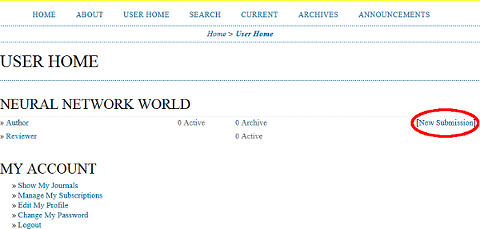
If you do not see the Author line, likely, you have not registered as such (people often forget to tick the appropriate box when registering). If you want to submit a new manuscript, go to the [New Submission] link. This will start the five-step submission process.
Submission Processing
Q: How long will the pre-review of my submission take?
A: All manuscripts are first screened by selected members of the IEB, and this process may take some time. However, it should not take more than four weeks before the Editor-in-Chief decides that the submission is unsuitable for the journal (out-of-scope, poor quality, etc.) or assigns an editor (the status of the submission changes from UNASSIGNED to IN REVIEW).
Q: How long does the reviewing process take?
A: This depends very much on the topic and quality of the submission. The Section Editor, assigned to your paper, starts to address potential reviewers as soon as the manuscript has been assigned. A reviewer generally has 14 days to accept the review task; after that, another reviewer is selected. After accepting the review, reviewers are given 4 weeks to deliver their judgment. It may take up to 30-60 review requests (i.e., 150 days) before a reviewer accepts the review, and we do not always get the promised review back in time (sometimes we even have to look for another reviewer after the review has not been delivered).
Q: How much time does it take to typseset my paper after it has been accepted by reviewers?
A: The main decisive factors are (i) the submission format (MS Word requires a mostly manual and time-consuming conversion to LaTeX), (ii) the quality of initial typesetting (most authors tend to typeset mathematics incorrectly), (iii) the need to re-format and re-index the list of references, (iv) the quality of images (see the separate FAQ topic), and finally (v) the linquistic quality of the paper. In the present time, accepted papers have to wait for approximately 3-5 months in a queue before we start the layout editing phase. The layout editing may take 1 day, but we have papers that need numerous iterations (and several weeks of work) before we may consider them acceptable for publication.
Q: How long will it take before my paper is published?
A: This is generally a sum of periods mentioned above. The time ranges from cca 6 months (LaTeX formatted and good quality papers, fast review, only minor revisions required) to more than 3 years (this is usually due to a long reviewing process and submissions that require more reviewing rounds)
Reviewing process
Q: How can I access the reviews?
A: Unfortunately, the current version of our Electronic Submission System does not provide direct access to reviews from your dashboard. They will be emailed to you by the Editor, except for extra files, which are stored within OJS. Those files can be accessed from the manuscript dashboard only. You will find them in the Peer Review block under the Uploaded file. See the image below the next answer.
Q: Where do I upload the revised manuscript?
A: You can do so from the REVIEW tab of your submission. Just upload a new Author version in the Editor Decision block as indicated below: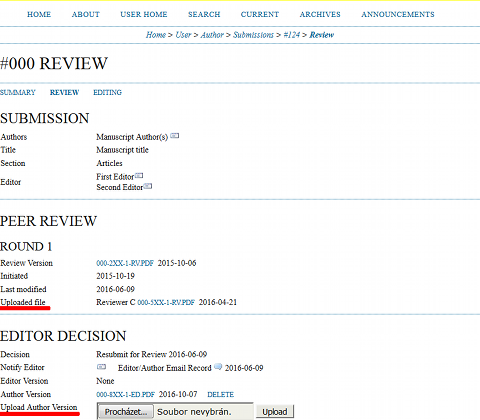
Layout Editing
Q: Why is the quality of my EPS/PDF files not acceptable?
A: Main problem with EPS/PDF files submitted by many authors is that they provide us with colour or greyscale images that have been exported from MS Word and then converted to EPS. These images usually have very low resolution and cannot be used for printing. As a rule of thumb, you may use a bitmap for a photograph or a screenshot, but all schemes, charts, and graphs should be provided as pure vector files. In cases where this is not possible, we require a high-resolution monochrome bitmap (at least 300dpi, which means approximately 1500px for a 10cm width of the image) so that the aliasing effects will not be visible.
Q: How can I produce vector EPS/PDF graphics from MS Word or MS Excel?
A: Modern MS Office programs can export documents directly to PDF. Such a document has to be post-processed, for example, in the Inkscape editor (open source, can be downloaded from here). The following internet posts provide more information about the entire process: How to export Excel plots to a vector image (EPS, EMF, SVG, etc.), and Export Excel graphs as vector graphics files (e.g., SVGs).
Q: May I provide the tables as pre-formatted EPS/PDF files for the layout editing round?
A: No. We always need "raw" data (in LaTeX or MS Word format) to prepare tables that are consistent with the journal's layout.
Journal History
Since 2013, the publisher of the Journal is the Czech Technical University in Prague, Faculty of Transportation Sciences
in cooperation with VŠB TU Ostrava
and the Institute of Computer Science, Czech Academy of Sciences.
January 2014 saw the resignation of the long-time Editor in Chief, Prof. Mirko Novák, from his post. The new Editor in Chief is Prof. Petr Bouchner.